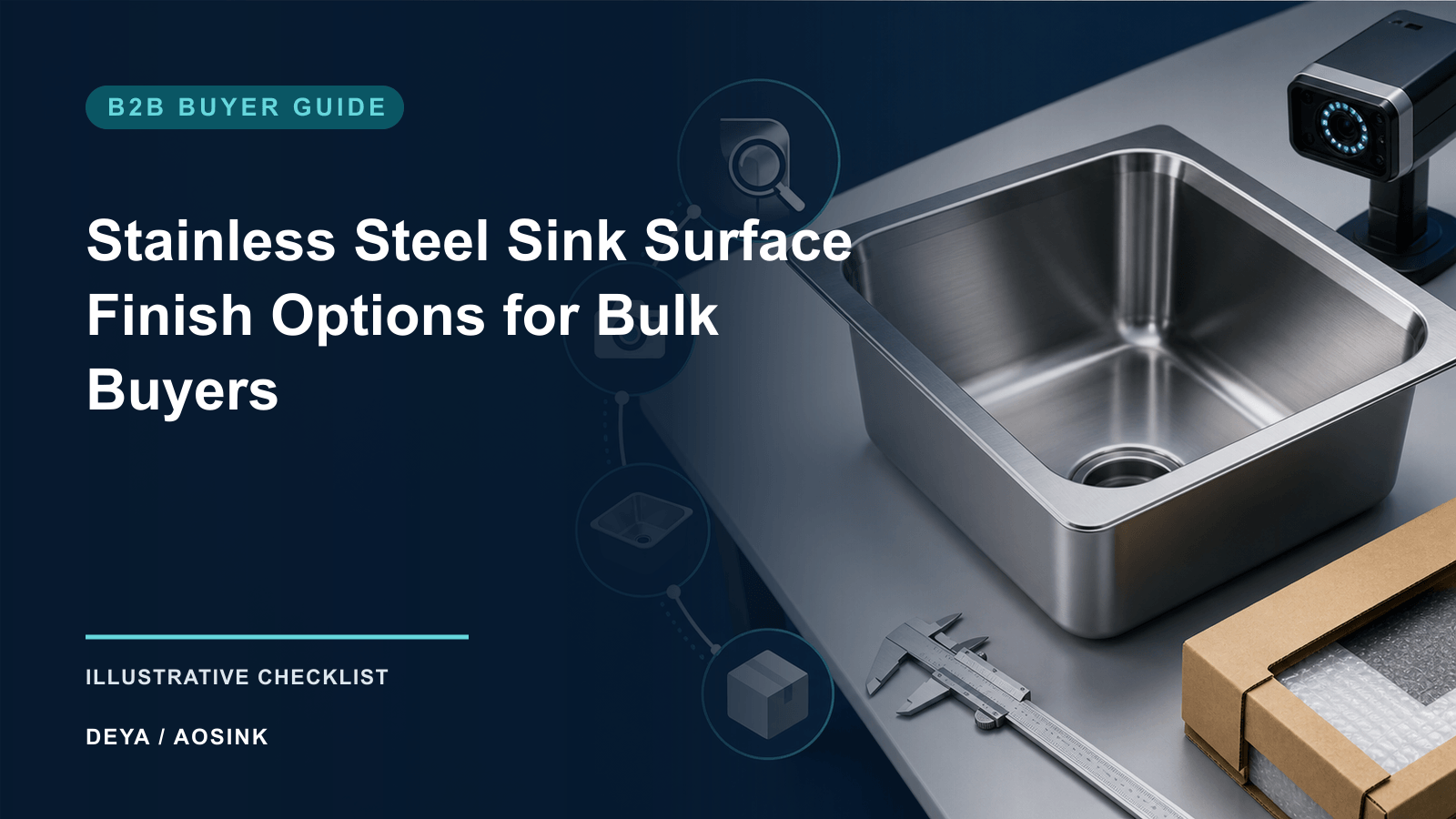
Answer for buyers: A stainless steel sink surface finish should be specified as a controlled purchasing requirement, not as a photo-based preference. Before a bulk order, define the finish type, grain direction, color or coating requirement, approved sample, protective film, acceptable defects, inspection method and replacement rule.
Surface finish is one of the first things a retail customer notices, but it is also one of the easiest details for B2B buyers to underspecify. Two quotations may both say “brushed stainless steel sink” while using different grain direction, polishing depth, coating, film protection, accessories, packaging contact points and defect standards. That is how a buyer can approve a nice sample, then receive a production lot with inconsistent gloss, visible handling marks or a color that does not match the showroom reference.
This guide is written for importers, distributors, project buyers and private-label brands preparing a stainless steel sink RFQ. It does not claim that every finish is available for every model, and it does not claim a specific certification for AOSINK. Instead, it explains how to turn finish selection into a clear specification that a factory, QC inspector and purchasing team can all verify.
Why finish choice affects more than appearance
A sink finish changes perceived value, maintenance expectations, packing risk and complaint handling. A matte brushed sink may be easier for many markets to understand because small water marks and directional scratches are less visually dramatic than on a mirror-like surface. A colored or coated sink may support a premium product line, but it needs tighter approval because color difference, edge coverage and cleaning instructions become part of the buyer’s promise to the market.
For export orders, finish should be discussed together with packaging. A well-finished sink can still arrive with rub marks if accessories, drain parts or cartons touch the bowl during transport. A procurement team should therefore approve both the surface and the packing method before mass production.
Main finish options buyers usually compare
| Finish option | Buyer value | What to specify | Inspection risk |
|---|---|---|---|
| Brushed or satin stainless steel | Practical, familiar and widely accepted for wholesale programs | Grain direction, uniformity, edge finish, film protection and approved sample | Mixed grain, uneven polishing or visible handling scratches |
| Fine hairline finish | Cleaner premium look for modern kitchen displays | Line direction, acceptable gloss range if measured and photo/sample reference | Inconsistent line density between bowl, rim and apron areas |
| Embossed or textured finish | Distinctive look and better visual masking of small marks | Pattern name, pattern direction, forming area and cleaning expectation | Pattern mismatch, difficult-to-clean corners or inconsistent forming marks |
| Colored PVD or similar decorative finish | Supports premium, design-led or regional color positioning | Color reference, coating area, drain/accessory color match and care wording | Color difference, edge variation, overpromising scratch resistance |
| Special anti-fingerprint or “nano” coating | Can support a marketing story if proven by sample and test | Coating supplier claim, test method, cleaning limitation and warranty boundary | Using vague terms without evidence; customer complaints after cleaning chemicals |
Use standards as a language, not as a decoration
Standards should help buyers write clearer orders. ASTM lists A240/A240M for stainless steel plate, sheet and strip for general applications, while ASTM A480/A480M covers general requirements for flat-rolled stainless and heat-resisting steel plate, sheet and strip. These references are useful when buyers discuss material and flat-rolled stainless requirements, but they do not replace a sink-specific drawing or approved finish sample.
For plumbing fixture context, ASME A112.19.3/CSA B45.4 is the stainless steel plumbing fixtures standard. For lot inspection planning, ISO 2859-1 describes sampling procedures indexed by AQL for inspection by attributes. A buyer can use these references to structure supplier discussions, but should avoid writing “certified” unless the supplier provides valid, order-relevant documents.
What an RFQ should say about finish
A weak RFQ says: “304 brushed sink, good quality, no scratches.” That is not enough for a comparable quotation. A stronger RFQ defines the product and the acceptance method.
- Base product: sink type, installation method, bowl size, drain position, rim design and accessory set.
- Material request: requested stainless grade or equivalent, plus whether a mill certificate or material test report is required.
- Finish name: brushed, satin, hairline, embossed, colored PVD, coated or another agreed term.
- Visible direction: grain direction on rim, bowl wall and bottom, especially for handmade and workstation sinks.
- Reference sample: one approved physical sample or signed photo set with date and revision number.
- Protection: protective film, bag, foam, corner protection, accessory separation and carton layout.
- Defect boundary: what counts as visible scratch, stain, dent, color difference, coating gap or polishing line problem.
- Inspection plan: sample size, visual distance, lighting condition and who has final acceptance authority.
How to approve a finish sample
Buyers should approve the finish on a real sink, not only on a small metal chip. A flat coupon may look clean, but a sink has corners, welded zones, drain holes, ledges, rims and formed walls. These areas reveal whether polishing, coating or pattern forming remains consistent after production steps.
During sample approval, photograph the sink from the same positions that will later be used for QC comparison: top view, bowl bottom, side wall, rim, drain area, ledge if present, faucet deck if present and underside if finish or coating may be affected by handling. Record lighting condition and whether water marks or fingerprints are acceptable after normal wiping. This turns a subjective discussion into a repeatable reference.
Brushed finish: common, but still needs control
A brushed stainless steel sink is often the safest starting point for distributors because it is familiar and practical. Still, “brushed” does not define the final product by itself. Buyers should confirm whether the grain is uniform across the rim and bowl, whether the drain cover matches the visual tone, and whether accessory contact may scratch the sink in the carton.
Industry guidance from the Australian Stainless Steel Development Association describes No. 4 finish as a directional surface produced with abrasive belts and commonly used where appearance matters. For sink buyers, the important lesson is simple: directional finishes need directional control. A production lot should not mix noticeably different grain directions or polishing depth under the same SKU.
Colored and coated finishes need stricter claim control
Colored sinks can help a brand stand out, especially in markets where black, gold, gunmetal or champagne finishes match cabinet and faucet trends. But colored finishes should be sold with careful wording. Do not promise “scratch-proof,” “never fades” or “chemical-proof” unless there is a specific test method and written evidence for that exact finish.
For a colored or coated sink order, ask whether the drain, overflow, faucet, basket, soap dispenser and bottom grid should match the same color family. If accessories are sourced separately, the finished set may look inconsistent even when the sink body is acceptable.
Textured or embossed sinks: check cleaning and forming details
Textured finishes can reduce the visual impact of small marks and create a stronger product identity. They also create extra details to inspect. Buyers should check whether the texture continues evenly across visible areas, whether the pattern direction is aligned, and whether corners or ledges collect residue in a way that retail customers may dislike.
If the texture is used mainly for marketing, make that clear in the product positioning. If it is being sold as easier to clean or more resistant to scratches, request evidence before using those claims publicly.
Finish inspection before shipment
Pre-shipment inspection should include a finish-specific section, not only dimension and carton checks. A practical inspection sheet can include:
- Approved sample or photo reference available to the inspector.
- Visual check under agreed lighting and distance.
- Top surface, bowl wall, bottom, rim, drain area and accessory contact points checked separately.
- Random carton opening to confirm protective film and accessory separation.
- Photo evidence of acceptable and rejected examples.
- Clear rule for minor, major and critical finish defects.
ISO 2859-1 can help buyers and inspectors discuss lot-by-lot sampling logic for attribute inspection. The final AQL level should be agreed commercially and technically before production, not after a dispute begins.
Recommended internal links
- Stainless Steel Sinks — link when explaining product families and finish availability.
- OEM / ODM Services — link when discussing private-label finish confirmation.
- Workstation Kitchen Sink Order Checklist — link for accessory and configuration confirmation.
- Contact Deya — link as the RFQ call to action.
Suggested RFQ wording
“We are sourcing stainless steel kitchen sinks for bulk wholesale. Please quote the attached model with the following finish requirements: brushed stainless steel surface, consistent grain direction on rim and bowl, approved sample required before production, protective film on visible surfaces, accessories packed separately to avoid rubbing, and finish inspection based on agreed visual standard before shipment. Please confirm available finish options, sample lead process, packing method and documents available for material verification.”
FAQ
Is brushed stainless steel always the best finish for wholesale sinks?
Not always, but it is often a practical baseline because buyers and end users understand it. Premium retail lines may require colored, textured or coated finishes, but those options need stronger sample approval and claim control.
Can a product photo replace a physical finish sample?
No. Photos are useful for early selection, but lighting and editing can hide grain, gloss and color differences. A physical sample is safer before bulk production.
Should buyers request 304 stainless steel for every sink?
Many buyers request 304 for premium kitchen sinks, but the order should define the required material and supporting document. Do not rely on marketing wording alone; ask what material proof can be supplied for the specific order.
Can a supplier claim a finish is scratch-proof?
Be careful with that wording. A more responsible approach is to define the finish, approve samples, state cleaning limitations and request test evidence if a scratch-resistance claim will be used in marketing.
Sources used for fact checking
- ASTM steel standards listing — includes A240/A240M and A480/A480M stainless steel standards.
- ASTM A480/A480M abstract — general requirements for flat-rolled stainless and heat-resisting steel plate, sheet and strip.
- ASME A112.19.3/CSA B45.4 — stainless steel plumbing fixtures standard page.
- ISO 2859-1 online browsing platform — sampling procedures for inspection by attributes.
- ASSDA No. 4 finish guide — practical notes on directional stainless surface finish.
CTA
To request a clearer quotation, send AOSINK your sink drawing or reference photo, target finish, order quantity, destination market, accessory set and packaging requirements. The more precisely the finish is defined at RFQ stage, the easier it is to compare quotations and prevent production disputes.
No responses yet