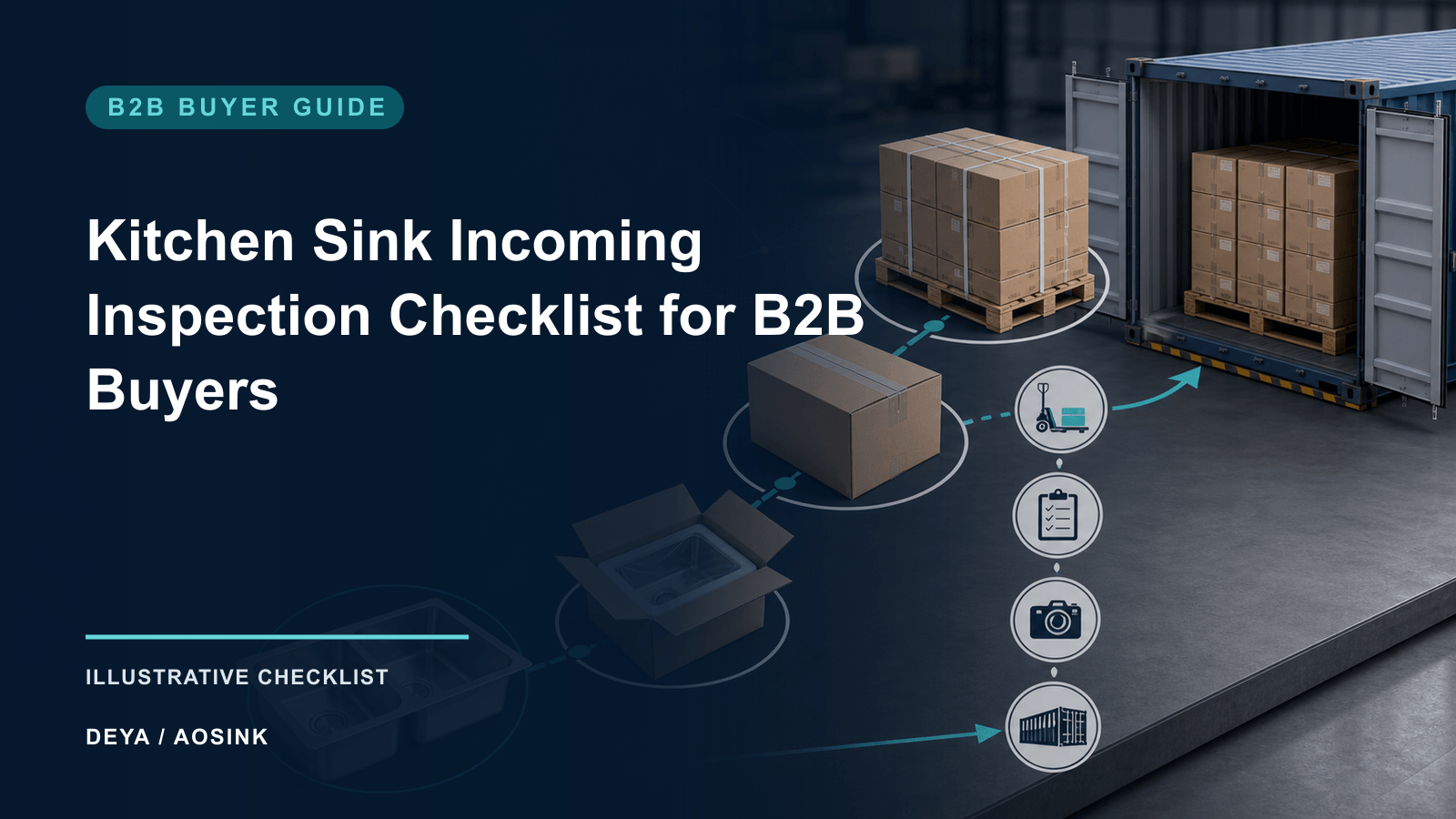
Short answer: do not release a bulk kitchen-sink delivery into stock just because the cartons arrived. Before put-away, reconcile the shipment with the purchase order, record the receiving condition, identify the lot or configuration you actually received, inspect the agreed sample, and open a time-stamped exception record for anything unresolved. The contract—not this article—should define acceptance, notice, risk, and remedy.
For an importer, distributor, project buyer, or OEM team, incoming inspection is the handoff between transport and sellable inventory. It is not the same as a factory pre-shipment inspection, container-loading review, or warranty claim. Its job is narrower: preserve evidence and stop an unverified delivery from being silently mixed into available stock.
Why an incoming inspection record matters
A sink can look acceptable from a distance while the delivered configuration, carton count, visible transit condition, or accessory scope still needs checking. Once cartons are put away, mixed with another revision, or unpacked without a record, a later discrepancy is harder to investigate fairly.
ISO 2859-1:2026 describes acceptance-sampling plans for lot-by-lot inspection by attributes. That does not make an AQL plan mandatory for every sink order, and it does not set an AOSINK inspection level. It does show why a buyer should agree the lot definition, sample method, checked attributes, and acceptance decision before using a sample as a release basis. ISO 28598-1 likewise describes incoming and customer inspection as contexts where parties may specify criteria in a contract.
For traceability, GS1 EPCIS/CBV guidance illustrates that a receiving event can associate the goods or shipping containers received with the receiving location and related transaction data. A sink buyer need not adopt EPCIS or serialise every basin to apply the practical idea: connect the receipt record to the PO, shipment reference, carton or pallet identifier, and confirmed product configuration.
What to agree before the truck arrives
The receiver cannot invent acceptance terms at the loading bay. The purchasing, quality, logistics, and warehouse teams should have one approved receiving instruction that answers these questions.
1. What is the inspection unit?
State whether the unit is a sellable SKU, carton, pallet, accessory kit, or a defined lot. A box count alone may not prove that the correct basin, finish, mounting configuration, drain-related component, or accessory scope was delivered. Use the order’s approved product data and packing documentation as the comparison baseline; do not infer unlisted parts from photographs or a product family name.
2. What evidence must be captured at arrival?
Decide who photographs the unloaded condition, where files are stored, how carton or pallet IDs are recorded, and who may sign a carrier receipt. Capture the carrier or vehicle reference, date and local time, receiving location, seal or shipment reference where applicable, and the condition visible before normal handling changes it. This is evidence gathering, not a conclusion about fault.
3. What triggers a hold?
Write down the hold triggers before receipt. Examples can include an unmatched PO or packing list, an unidentified carton, visible puncture or crushing, wet packaging, mixed or missing labels, quantity variance, or a sample result outside the agreed rule. These are examples only. The actual trigger, urgency, inspection scope, and release authority belong in the order-specific procedure.
The receiving sequence: identify, observe, inspect, decide
Step 1: Reconcile documents and identifiers
Start with the PO, approved order revision, packing list, commercial and transport references supplied for the shipment, and any agreed inspection plan. Record what is present and what is not. Match carton, pallet, or lot identifiers to the records where they exist. If a label does not identify the delivery well enough to reconcile it, isolate that unit rather than guessing from appearance.
Step 2: Record condition before routine put-away
Photograph the shipment in context and make a count by the agreed unit. Note plainly observable conditions: intact, crushed, punctured, wet, opened, relabelled, or otherwise abnormal. Keep the original image files and record who took them. Do not write “transit damage,” “supplier defect,” or “accepted” merely from a first look; those conclusions require the contract, the agreed checks, and the appropriate review.
Step 3: Verify quantity and configuration against the order
Compare received quantities with the packing list and PO. For selected units, compare product identity and included scope to the approved configuration record. This may mean checking the carton label, an order-controlled drawing, a packing declaration, or an agreed sample point—not measuring or claiming specifications that the purchase documents do not establish.
Step 4: Inspect the agreed sample and record results
If the parties use sampling, follow the agreed lot definition, selection method, attributes, sample size, and acceptance rule. ISO 2859-1:2026 is a useful reference when parties deliberately choose an AQL-indexed attribute-sampling approach, but an ISO reference alone is not an inspection plan. Record the actual units examined, observed results, and any deviations from the plan. Never backfill a sampling basis after a disagreement begins.
Step 5: Segregate exceptions and issue a discrepancy record
Physically or systemically hold affected units so that they are not allocated, installed, relabelled, or blended with confirmed stock. Link the discrepancy record to the shipment, PO revision, observed condition, photos, count, inspection results, and the receiver’s name. State what needs review; do not predetermine liability, insurance coverage, warranty coverage, replacement, or credit.
Step 6: Release only with recorded authority
The final status should be explicit: released, conditionally released under a documented restriction, held pending review, or rejected under the parties’ agreed process. Identify the decision maker and date. A signed delivery receipt, a warehouse scan, or carrier notification may have different meanings under the contract and chosen Incoterms® rule. ICC guidance stresses that delivery and risk-transfer points should be stated precisely; obtain qualified advice for the sale contract and local rules.
A practical incoming-inspection record
| Record field | Why it helps | Do not assume |
|---|---|---|
| PO number and approved revision | Connects the receipt to the agreed commercial and product baseline | That a PO proves every physical detail |
| Shipment, carrier, or container reference | Preserves the handoff context | That it decides responsibility |
| Receipt date, time, and location | Establishes a usable chronology | That a time alone proves when damage occurred |
| Carton/pallet/lot identity | Keeps units traceable during review | That every sink must be serialised |
| Count by agreed unit | Reveals a quantity variance | That carton count proves contents |
| Pre-handling photos and condition notes | Preserves observable arrival evidence | That appearance proves defect cause |
| Sampling plan and actual sample | Makes a sample decision reviewable | That a generic AQL label is enough |
| Hold/release decision and owner | Prevents accidental allocation | That a warehouse signature settles a claim |
Questions to include in the PO or receiving instruction
- Which documents and identifiers must match before stock can be released?
- What is the lot, and which units are included or excluded from the inspection?
- Which visible-condition, quantity, identity, configuration, and accessory checks are required?
- If sampling is used, what sampling standard or plan, selection method, sample size, and acceptance rule were agreed?
- Which conditions require immediate photographs, segregation, and written notice—and to whom?
- Who may approve a conditional or full release, and where will the evidence be retained?
Avoid four common receiving errors
Treating the delivery receipt as final acceptance
Receipt signatures can acknowledge arrival, but their meaning depends on the contract, carrier documentation, and applicable law. Keep the operational act of receiving separate from an acceptance or liability conclusion unless the authorised commercial process says otherwise.
Mixing stock before review is complete
Mixing cartons from different orders, revisions, or conditions destroys the evidence trail. A clearly marked hold location or system status protects both buyer and supplier while facts are reviewed.
Calling every carton issue a product defect
Carton condition, product condition, packing design, loading, handling, and contractual responsibility are different questions. Report the observation with evidence first; let the responsible reviewers assess cause and remedy.
Applying a generic sampling rule without agreement
An AQL label does not answer what a lot is, which characteristics matter, how units are selected, or who has authority to accept. Document those choices before receipt, not after an exception.
Build a repeatable receiving workflow
A scalable process has three short layers: a warehouse intake check, a quality or product-configuration check, and a commercial exception route. Keep it proportional to the order and risk. The same principle applies whether you buy handmade stainless-steel sinks, workstation configurations, or a private-label range: preserve the evidence needed to compare what arrived with what was agreed.
For related buying-stage controls, see AOSINK’s guides to workstation sink order confirmation, choosing a wholesale stainless-steel sink supplier, and black workstation sink configuration review.
Request a receiving-control pack
If you are preparing a bulk or OEM sink program, send AOSINK your product configuration, order stage, destination, and the receiving fields your warehouse requires. We can discuss which documentation can be confirmed for a specific quotation and order; no product, packing, inspection, delivery, or remedy commitment is implied by this article.
FAQ
What should be checked when a bulk kitchen-sink shipment arrives?
Match the delivery to the PO and packing records, record the arrival condition before routine handling, verify counts and identifiers, inspect the agreed sample, and segregate anything unresolved. The exact acceptance criteria must come from the order-specific agreement.
Is a signed carrier receipt the same as accepting kitchen sinks?
Not necessarily. A receipt can serve different functions under the contract, carrier document, and applicable law. Keep an operational receipt record separate from an acceptance, liability, or remedy decision unless authorised reviewers state otherwise.
Should an importer use AQL for incoming sink inspection?
Only if the parties have agreed a suitable sampling plan. ISO 2859-1:2026 describes AQL-indexed acceptance-sampling schemes, but it does not select your lot definition, checked attributes, sample size, or contract terms for you.
What if cartons are damaged but the sinks look fine?
Photograph and record the observed carton condition, identify the affected units, and follow the agreed hold and notice procedure. Do not conclude that the product is defect-free or that a particular party is responsible without the required review.
How long should incoming-inspection records be kept?
Use the retention period agreed in the contract, quality procedure, insurance requirements, and applicable law. Link the records to the PO, shipment references, configuration, and any later exception record so they remain reviewable.
Sources and editorial boundary
- ISO 2859-1:2026, published January 2026; current ISO page checked July 28, 2026.
- ISO 28598-1:2017, confirmed June 2024; current ISO page checked July 28, 2026.
- GS1 EPCIS and CBV 2.0 guideline, ratified March 2023; current guideline checked July 28, 2026.
- ICC guidance on delivery and risk transfer, current guidance checked July 28, 2026.
These sources provide general quality, traceability, and trade-documentation principles. They do not establish a kitchen-sink requirement, an AOSINK certification, an AOSINK sampling plan, a product specification, delivery term, warranty, cause of damage, or legal outcome. Have qualified quality, logistics, commercial, and legal reviewers approve the order-specific procedure.
No responses yet