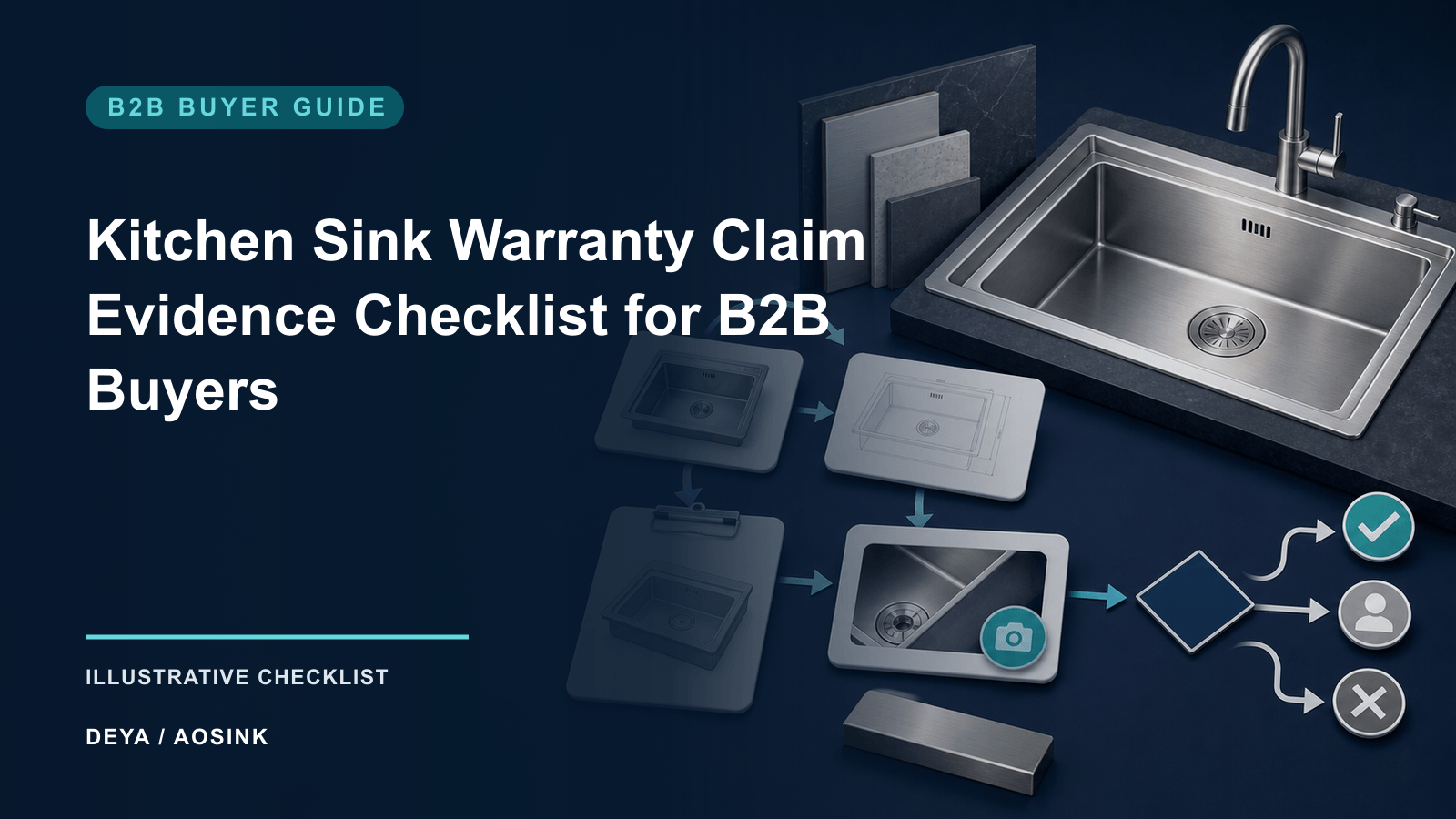
Short answer: treat a kitchen sink warranty claim as an evidence-and-decision workflow, not as an automatic replacement request. Capture the exact model and revision, supplied component scope, order and receiving trail, installation context, time-stamped condition evidence, and requested resolution. Then agree who will assess the case and record the decision.
This guide is for importers, distributors, project buyers, and OEM/ODM teams. It is an editorial procurement checklist—not legal advice, a warranty policy, a product-performance claim, or an AOSINK commitment.
Why a claim file needs more than a photo
ISO 10002:2018 provides general guidance for product and service complaint handling. GS1’s Global Traceability Standard distinguishes product-identification levels and supply-chain event data. ISO 10007:2017 provides general configuration-management guidance. They are principles for connecting a claim to the correct product and transaction, not sink warranties or universal marking rules.
| Evidence can establish | Evidence cannot establish by itself |
|---|---|
| What was reported, when, and what was submitted. | Supplier liability or a specific remedy. |
| Whether a claimed unit can be associated with a model, revision, order, delivery, or agreed identifier. | That a product, installation, or component met a contract or code requirement. |
| Whether the available order documents describe the same configuration. | Manufacturing cause, installation correctness, or warranty coverage. |
1. Open one controlled case record
Use a unique case number. Preserve the first report and add dated updates. Acknowledge receipt without implying acceptance.
- Case number, report date, reporting organization, contact, and location.
- PO line, supplier acknowledgement, invoice or delivery reference where available.
- Model code, drawing/product-data revision, ordered configuration, and claimed quantity.
- Reported issue separated from any later technical assessment.
- Requested resolution, owner, agreed next action, and status.
2. Identify the supplied configuration before diagnosing it
| Field | Evidence to request | Buyer control |
|---|---|---|
| Base sink identity | Model and drawing, product-data, or approved-sample reference. | Do not identify a model only from a marketing photo. |
| Revision and options | Revision date, finish/options, mounting reference, agreed custom changes. | Match the revision actually ordered. |
| Supplied scope | Itemized accessory, drain, hardware, label, manual, and packaging list. | Compatibility does not prove inclusion. |
| Traceability marker | Lot, batch, serial, carton, pallet, or other agreed identifier. | Do not invent an identifier or assume universal marking. |
For workstation products, compare the received set with the order’s component list. See AOSINK’s workstation kitchen sink order checklist for related pre-order control.
3. Capture condition evidence without changing the scene prematurely
- Wide images of the item, packaging, and location.
- Close images or video of the reported area.
- Labels, carton marks, or agreed identifiers, without exposing confidential data.
- Receiving notes, delivery-condition notes, and any handover exception.
- Installation photos and applicable documents where the issue concerns fit, mounting, drainage, or use.
- A receipt-to-report timeline and record of any intervention.
Do not require a site team to dismantle plumbing, remove a sink, or perform a risky test merely to complete a claim file. Follow qualified installers, the project specification, and local safety requirements.
4. Separate product, transit, installation, and scope questions
| Question | Useful evidence | Do not assume |
|---|---|---|
| Was the configuration ordered? | PO, packing list, receipt images, component count. | A compatible part was included. |
| Was a condition noted at receipt? | Delivery note, carton images, carrier exception, receiving log. | The condition occurred in transit. |
| Does installation match applicable information? | Model documents and qualified site reporting. | Counter, cabinet, plumbing, support, sealant, or labor scope was correct. |
| Is there a recurring pattern? | Case category, configuration, dates, quantities, and agreed identifiers. | One claim establishes a batch- or model-wide condition. |
For visible configuration context only, see AOSINK’s Model 7548 buyer’s guide; it does not replace an order-specific drawing or warranty record.
5. Agree the review path before promising a remedy
- Intake: log and acknowledge without accepting responsibility.
- Completeness check: request only relevant missing evidence.
- Configuration check: match order, revision, scope, and identifier.
- Assessment: assign quality, engineering, installation, logistics, or commercial reviewers.
- Decision: document the finding, fact basis, agreed action, owner, and effective date.
- Closure and learning: retain the record and review meaningful patterns.
ISO 10002 can support analysis and improvement; it does not determine the legal outcome of a dispute or create a mandatory contract procedure.
6. Use claim data to improve the next order
Group retained records by category, model/revision, sales channel, receiving stage, and agreed outcome. This can reveal unclear data, packaging, component-list, or training needs. Do not publish a quality rate, failure rate, warranty rate, or product claim without reliable data, a valid comparison basis, and disclosure approval. For initial supplier assessment, see AOSINK’s wholesale supplier-selection guide.
Copy-ready case-opening request
Please open a controlled claim record for the reported kitchen sink issue. Please confirm the case number and requested evidence. We will provide the PO/order reference, product model and revision, supplied-component list, receiving and installation context where applicable, time-stamped condition images, and the requested resolution. This submission is for assessment and does not itself determine cause, warranty coverage, responsibility, or remedy.
FAQ
Is a warranty claim the same as proof of a manufacturing defect?
No. A claim is a reported issue and request for review. Cause, coverage, responsibility, and remedy require the evidence and process agreed by the parties.
What is the most important record for a kitchen sink claim?
The order-controlled configuration: model, revision, options, and supplied scope. Link it to the PO or delivery trail and condition evidence rather than relying on a photo alone.
Should every kitchen sink have a serial number for warranty claims?
Not necessarily. GS1 describes class-, batch/lot-, and instance-level identification as different traceability choices. The appropriate level depends on objectives, systems, product, and agreement.
Can a distributor promise a replacement when opening a claim?
Only if the distributor has authority and the relevant agreement supports it. Intake acknowledgement should normally confirm receipt and next steps, not decide the remedy.
Do installation photos prove the sink caused an issue?
No. They add context for a qualified review; they do not establish installation correctness, product cause, code compliance, coverage, or liability.
Next step
Before the next kitchen sink order is released, agree a one-page claim-intake form with supplier and distributor teams, tie it to the order-controlled configuration, and have commercial, quality, engineering, and qualified local advisers confirm the process.
Sources and fact boundary
- ISO 10002:2018 — guidelines for complaints handling
- GS1 Global Traceability Standard
- ISO 10007:2017 — guidelines for configuration management
The sources describe general principles. The sink-specific checklist is editorial guidance only and does not state an AOSINK warranty, coverage period, claim process, test, material grade, certification, serialisation practice, capacity, lead time, replacement policy, or legal conclusion.
No responses yet