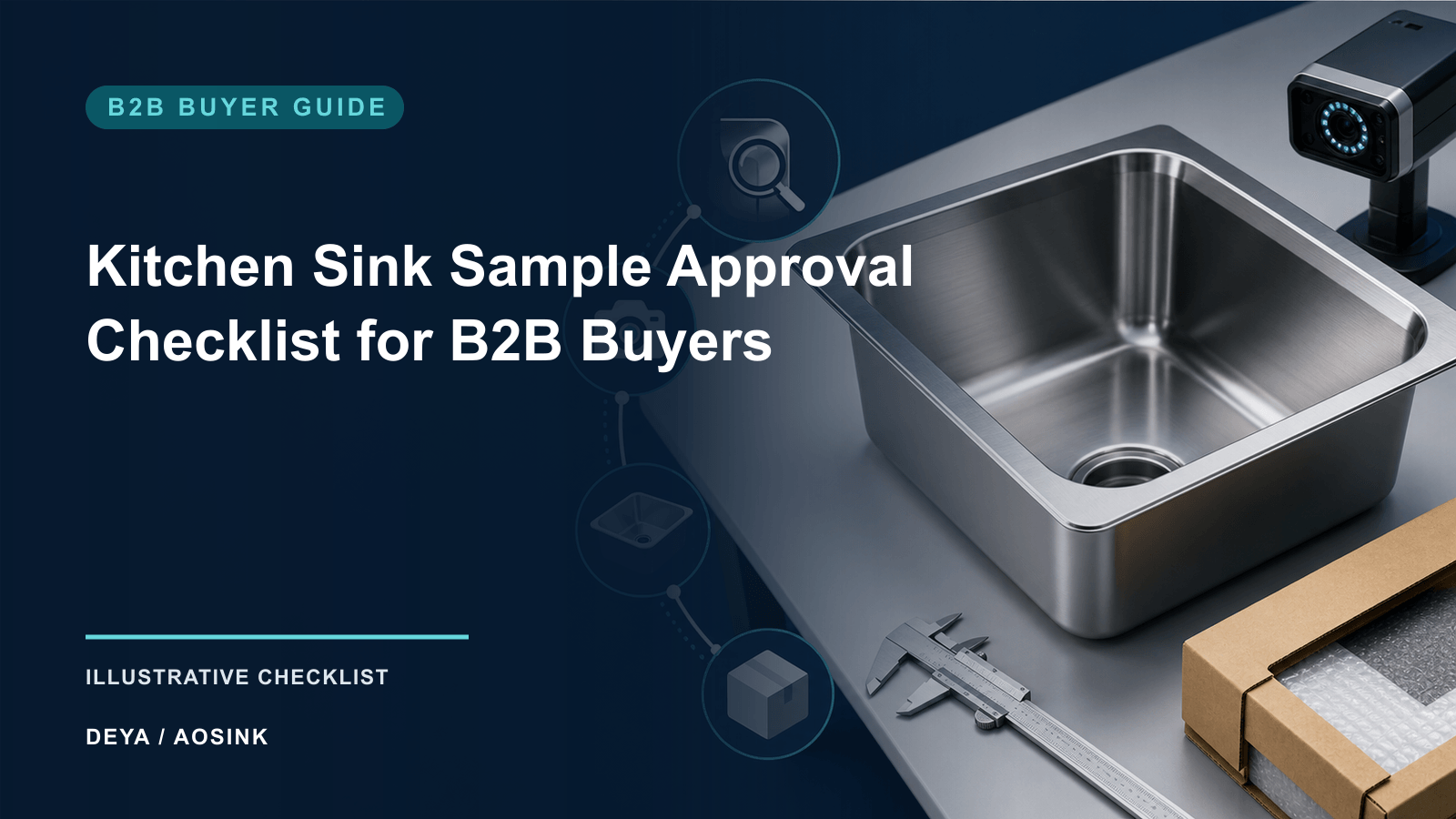
A kitchen sink sample should be approved against a written specification, not against memory or a few chat messages. For a B2B order, the approval record should connect the physical sample to a drawing revision, finish reference, component list, packaging plan and inspection method. If one of those items changes, the approval needs a controlled update.
This checklist is for importers, distributors, private-label brands and project buyers reviewing a stainless steel sink before trial or mass production. It is a purchasing control guide, not a claim that every test applies to every model or destination market.
What sample approval is meant to prevent
The purpose is to stop an attractive prototype from becoming an ambiguous production standard. A sample may look correct while still leaving open questions about finished dimensions, hole positions, accessory fit, drain components, protective film, carton contents or label data. Those gaps become disputes when the production lot arrives.
Use the sample to close decisions. Record each decision in a signed or otherwise controlled approval sheet. A photograph is useful evidence, but it cannot replace measured values or a revision-controlled drawing.
1. Identify the exact sample
- Supplier, buyer and project name
- Model or buyer SKU
- Drawing number and revision
- Sample date and unique sample ID
- Material and finish stated by the supplier
- List of included and excluded accessories
Photograph the complete sample, its labels and every included component. Keep the photos with the approval sheet. Do not treat a showroom display as a production reference unless it is formally linked to the order documents.
2. Check installation-controlling dimensions
Measure the features that control fit: overall length and width, bowl dimensions, bowl depth, rim or flange, drain location, faucet holes, overflow opening where specified, workstation ledges and any cut-out template. The buyer and supplier should agree where each dimension is measured and whether the requirement applies to the finished sink.
Do not invent tolerances after a disagreement. Put tolerances on the approved drawing before production. Where a countertop cut-out or cabinet is already fixed, identify the critical dimensions separately so they receive extra attention.
3. Verify the material documentation boundary
A visible inspection cannot establish a stainless-steel grade. If grade identity matters, define the required material record, traceability and verification method in the purchase specification. ASTM A240/A240M is an authoritative material specification covering chromium, chromium-nickel and chromium-manganese-nickel stainless plate, sheet and strip, including chemical-composition and mechanical-property requirements. Referencing the standard does not prove that a particular sink complies; the buyer still needs agreed evidence for the supplied material.
Record how thickness will be stated and checked. Clarify whether the supplier is quoting nominal incoming sheet thickness, measured finished-product thickness at an agreed location, or another definition. Do not compare suppliers using an undefined gauge label.
4. Approve appearance under repeatable conditions
Review the sample under consistent lighting and from agreed viewing distances. Check visible surfaces for scratches, dents, discoloration, inconsistent brushing, polishing marks, coating variation and damage around holes or edges. Mark which surfaces are cosmetic class-A areas and which are normally concealed.
For a colored or coated finish, retain a controlled physical reference if practical. A phone photo can shift color and gloss, so it should support—not replace—the approved finish standard.
5. Check bowl geometry and water path
Inspect corner formation, bottom geometry, drain position and transitions around the outlet. Conduct the agreed water test on a level setup. Record the method, duration and observation criteria. Avoid absolute claims such as “zero water remains” unless the buyer has defined a repeatable measurement method.
ASME A112.19.3/CSA B45.4 is the joint standard titled Stainless Steel Plumbing Fixtures. Buyers selling into markets where it is relevant should determine the applicable requirements and evidence with a qualified compliance professional. A sample photo or supplier statement is not a certification.
6. Test every included accessory as a system
For workstation models, place each cutting board, colander, rack, tray, basket or bottom grid in its intended position. Check that the accessory is stable, moves through the intended working area, does not damage the finish and can be packed without forcing or distortion.
Confirm accessory dimensions, material, finish, quantity and replacement part identity. Similar-looking accessories from different batches are not automatically interchangeable.
7. Assemble the drain and optional components
Confirm the waste strainer, seals, pipes, overflow parts and fasteners included in the quotation. Trial-assemble them in the intended sequence. For faucets, soap dispensers, cup washers or controls, verify the hole pattern, mounting clearance and under-counter space against the drawing.
Record components that are display-only. The suggested article image shows a feature-rich sample, but it cannot establish which components are included in any commercial order.
8. Approve packaging with the product
Review surface film, rim protection, corner protection, accessory containment, carton marks, labels and instructions. Confirm that loose metal parts cannot move against the bowl during transport. If the buyer requires a packaging test, define the method and acceptance criteria rather than relying on the phrase “export packaging.”
9. Classify approval results
| Result | Meaning | Next action |
|---|---|---|
| Approved | Matches the controlled specification | Freeze the approved revision and reference sample |
| Approved with conditions | Specific corrections are accepted without a new full sample | List each correction and required evidence |
| Resample required | Fit, function, appearance or scope remains uncertain | Issue a revised drawing and inspect a new sample |
| Rejected | Sample does not meet the agreed requirement | Record nonconformities and stop approval |
10. Convert the approval into a production control
Attach the final checklist, drawing, photos, component list and packaging reference to the purchase order or quality agreement. Define which production-lot checks repeat the sample checks. ISO 2859-1:2026 provides AQL-indexed acceptance-sampling schemes for lot-by-lot inspection by attributes; the buyer must still select an appropriate plan and acceptance criteria for the actual risk.
Frequently asked questions
Is one approved sink sample enough for mass production?
One sample can establish a reference, but it does not prove lot consistency. Production controls, traceability and an agreed inspection plan are still required.
Can a buyer approve a sink from photos or video?
Remote evidence can confirm visible points, but it is weak for dimensions, tactile finish, assembly and accessory fit. Identify which checks were remote and which require a physical sample or independent inspection.
What happens if an accessory changes after approval?
Treat it as a controlled change. Update the component list, check fit and packaging, and record who approved the new revision.
Should the golden sample be kept?
Keep a clearly identified reference sample when practical, together with photos and documents. Define storage time and what happens if the sample is damaged or the design is revised.
No responses yet