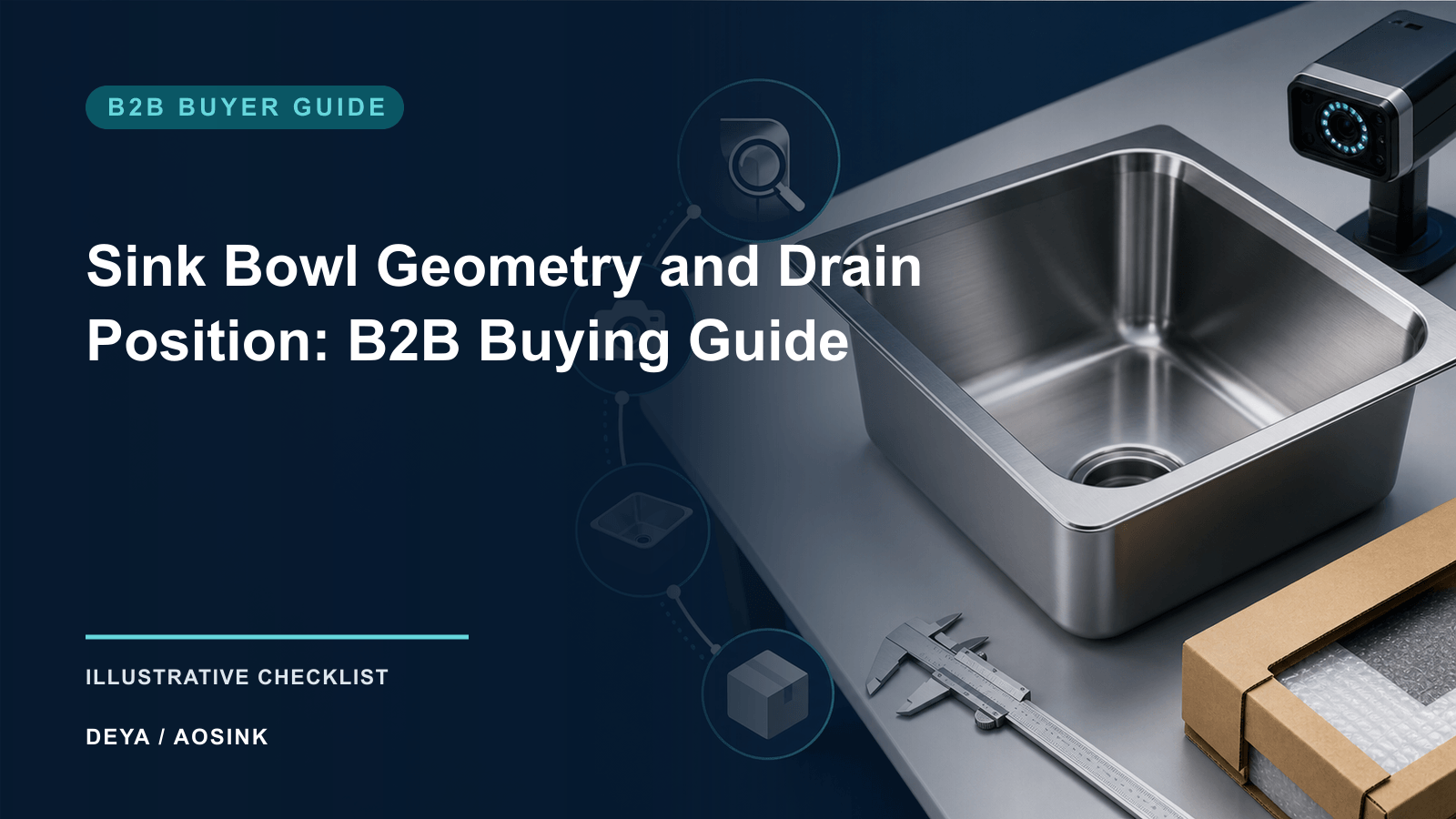
Sink bowl geometry and drain position affect usable space, cleaning access, accessory fit and under-counter planning. They should be evaluated as a system—not as isolated marketing features. A deeper bowl is not automatically better, an offset drain is not automatically more efficient, and visible slope lines do not by themselves prove complete drainage.
This guide gives global B2B buyers a practical comparison method without prescribing one universal design. Final selection depends on cabinet layout, countertop, plumbing, user needs and destination-market requirements.
Begin with the installation envelope
Before comparing bowls, record the cabinet’s internal width, usable height, drawer or shelf conflicts and plumbing route. Add the countertop cut-out and mounting method. A bowl that looks spacious in a product photo may leave insufficient clearance for clips, faucets, waste fittings or a disposer.
Ask for a finished-product drawing. Overall sink size, bowl opening and internal bowl dimensions are different measurements. Keep them in separate fields.
Usable bowl space is more than length × width × depth
Internal corner radius, side-wall angle, bottom transitions, drain cover and accessory ledges all change the space available for cookware. Compare the actual internal geometry at relevant heights. If large trays, pans or commercial utensils matter, test those items in a sample rather than relying on a volume calculation.
Depth can improve containment, but it also affects reach, cabinet space and drain elevation. A project buyer should review countertop height and intended users instead of selecting the deepest available model by default.
Corner geometry changes both use and manufacturing control
Tighter-looking corners can create a sharp visual style and maximize some flat dimensions, while larger radii may be easier to wipe. The real choice depends on the formed or fabricated construction, finish quality and the buyer’s cleaning expectations.
Inspect consistency where side walls meet the bottom. Look for uneven transitions, polishing variation, visible distortion or crevices that differ from the approved sample. Do not infer manufacturing method solely from appearance; request process information when it matters to the specification.
Understand center versus offset drains
A center drain creates a balanced visual layout and may simplify some accessory arrangements. An offset drain may preserve uninterrupted working space in part of the bowl or change the under-counter plumbing position. Neither option is universally superior.
For each design, confirm:
- Drain center coordinates from stable datums
- Waste fitting and strainer compatibility
- Clearance below the bowl
- Interaction with drawers, shelves and disposers
- Bottom-grid or drain-cover fit
- Water-test method and acceptance criteria
Do not judge drainage from stamped lines alone
Visible grooves or an X-pattern may indicate intended water paths, but the finished result also depends on the complete bottom geometry, level setup, outlet assembly and manufacturing variation. Verify an actual sample on a level test setup.
Define what the test records: flow toward the outlet, visible pooling after an agreed time, leakage at the waste assembly, or another measurable characteristic. Avoid vague claims such as “fast drainage” unless a repeatable test supports them.
Evaluate the overflow and deck features
If the model includes an overflow, identify its opening, components, connection and cleaning access. Confirm whether the overflow kit is included in the quotation and packaging. Where the sink has a rear deck, check faucet-hole spacing, accessory holes and under-deck clearance.
The suggested photo shows a display sink with a faucet and an offset drain. It is suitable for discussing visible geometry only; no plumbing performance or supplied-component claim should be derived from it.
Match geometry to accessories
Bottom grids, drain covers, baskets and workstation accessories must fit the actual bowl shape. A small change in corner radius or internal taper can make an accessory unstable. Require part numbers or controlled drawings for paired accessories.
Place each accessory in the sample and check support, clearance and contact points. Confirm that metal parts cannot scratch the bowl during use or shipping under the agreed design.
Build a comparison matrix for buyers
| Decision | Evidence to request | Common error |
|---|---|---|
| Usable bowl space | Finished drawing and sample fit check | Comparing only overall dimensions |
| Drain position | Coordinates, plumbing layout and waste kit | Choosing from appearance alone |
| Drainage behavior | Agreed level water test | Treating decorative lines as proof |
| Corner geometry | Radius dimensions and visual standard | Ignoring cleaning and consistency |
| Accessory fit | Paired sample or interface drawing | Assuming nominal sizes interchange |
| Cabinet clearance | Section drawing and under-counter layout | Reviewing the top view only |
Turn the decision into an inspection plan
Mark installation-critical dimensions, drain location and accessory interfaces on the approved drawing. Add visual criteria for bowl transitions and finish. If production is accepted by sampling, select the sampling plan and acceptance criteria before manufacture.
ISO 2859-1:2026 defines AQL-indexed sampling schemes for lot-by-lot inspection by attributes. It does not choose the buyer’s defect classifications or acceptance levels; those remain commercial and technical decisions.
Frequently asked questions
Is an offset drain better than a center drain?
It depends on bowl use, plumbing and cabinet layout. Compare usable work area, waste-fitting clearance and accessory fit for the actual project.
Do X-shaped drainage lines guarantee no standing water?
No. They are visible geometry, not proof of a measured result. Test a finished sample on a defined level setup and record the observation criteria.
How deep should a kitchen sink be?
There is no universal answer. Balance cookware size and splash containment against user reach, countertop height and under-counter clearance.
Can buyers compare bowl capacity from catalog dimensions?
Only approximately. Corner radii, taper, ledges and drain parts change usable volume. Use drawings and sample fit checks for critical applications.
No responses yet