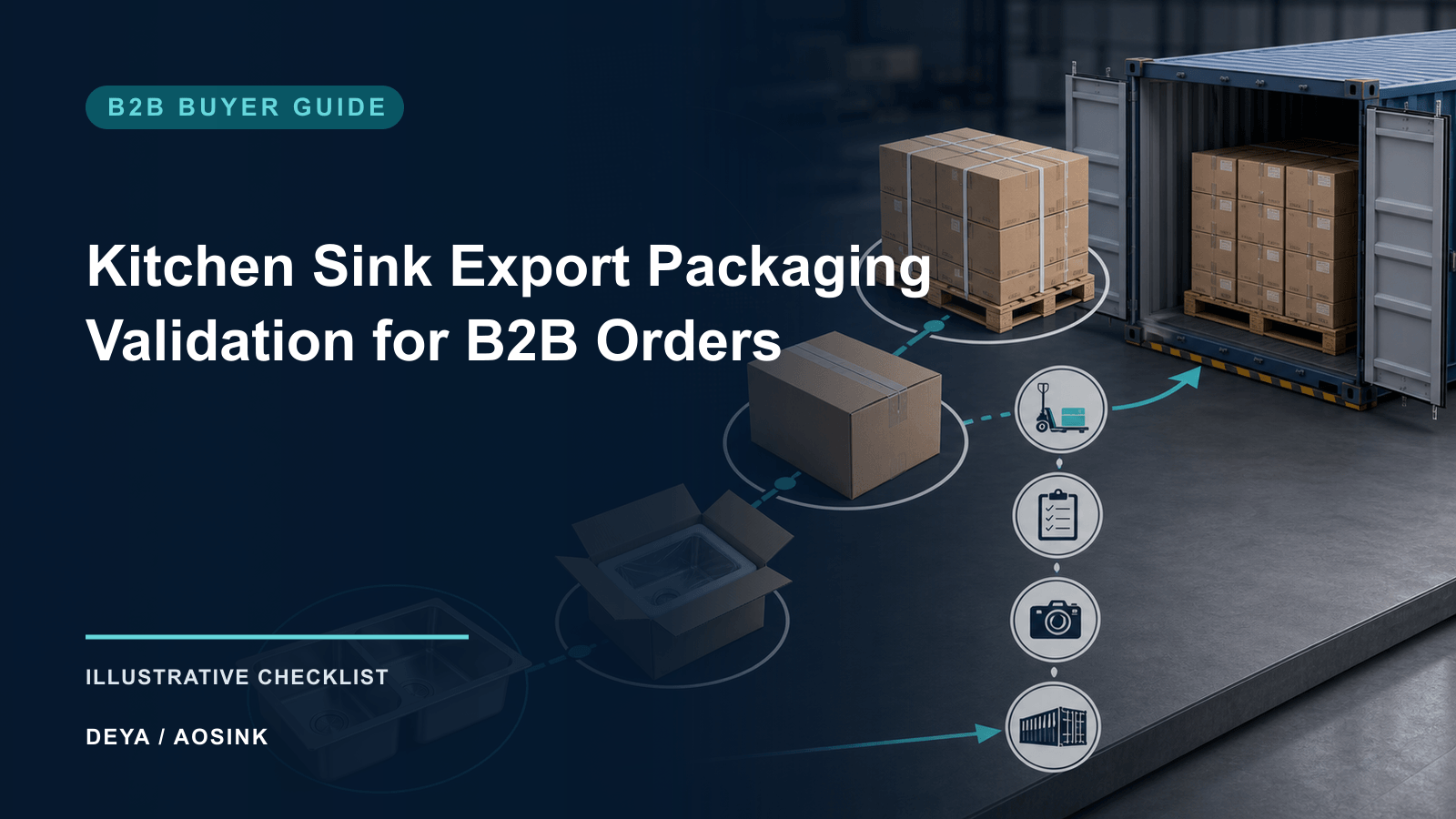
Export packaging should be approved as a product specification, not described only as “standard export carton.” A stainless steel sink can leave production in acceptable condition and still arrive scratched, dented or incomplete because the protective film, accessory restraint, rim protection or carton identification was not defined.
This guide helps B2B buyers turn packaging into measurable purchase-order requirements. It does not prescribe one universal pack: sink geometry, accessory weight, route, handling and destination rules differ.
Start with the actual shipment configuration
Record the exact sink model, finish, included components, pack quantity, carton orientation and pallet requirement. Validate the same configuration that will ship. A test using an empty carton or a sink without its heavy accessories cannot demonstrate the risk of the commercial pack.
Map the main damage paths
- Metal accessories moving against the bowl or rim
- Concentrated loads on corners, drain openings or workstation ledges
- Protective film lifting or trapping abrasive particles
- Nested sinks rubbing because separators move
- Moisture weakening cartons or obscuring labels
- Parts omitted because the bill of materials and packing list disagree
Photograph each layer during a packing trial. The record should show where every loose component sits and what prevents movement. A closed-carton photo is not enough.
Define observable acceptance criteria
| Control point | Evidence to request | Example decision |
|---|---|---|
| Visible surfaces | Before/after photos under agreed lighting | No new dent, scuff or coating damage |
| Accessory restraint | Layer photos and unpacking record | No free metal-to-metal movement |
| Carton identity | Approved artwork and readable sample | SKU, quantity and handling marks match PO |
| Completeness | Component checklist | All ordered parts and documents present |
| Pack consistency | Inspection record from sampled cartons | Pack follows the approved configuration |
If the buyer requires a transport test, name the method, conditioning, sequence and pass/fail criteria in the agreement. Do not imply that a package meets a test standard without a report tied to the exact pack configuration.
Separate packaging approval from production inspection
A successful trial pack establishes a reference; it does not prove every production carton matches it. Add packaging checkpoints to the pre-shipment inspection: carton dimensions and markings, protective materials, accessory placement, seals, quantity and visible damage after unpacking.
ISO 2859-1:2026 defines AQL-indexed sampling schemes for lot-by-lot inspection by attributes. It can structure sampling, but the buyer must still define the lot, defect classes, inspection level and acceptance criteria. An AQL value is not a promise that a shipment contains no defects.
Control revisions
Assign the packaging specification a revision number. Changes to carton grade, inserts, film, nesting method, accessory location or pallet pattern need documented review. Require the supplier to identify a proposed substitution before use; “equivalent material” is too vague when the change affects protection or labeling.
Buyer checklist before approving the pack
- Link the pack to the exact product and accessory bill of materials.
- Approve layer-by-layer photos and carton artwork.
- Define damage, completeness and labeling criteria.
- Specify any required transport test and evidence.
- Add repeatable packaging checks to final inspection.
- Freeze the approved revision and change-notification rule.
Frequently asked questions
Is “five-layer carton” a complete packaging specification?
No. It does not define board performance, dimensions, inserts, closure, sink restraint, accessory placement or the actual shipment configuration.
Should accessories be packed inside the sink?
They can be, but only with effective restraint and separation. Heavy or sharp components must not move against finished surfaces.
Does a drop-test video prove compliance?
Not by itself. The buyer needs the exact pack identity, method, sequence, observations and acceptance criteria; formal claims require the appropriate report.
When should packaging be revalidated?
After a product, accessory, packaging-material, pack-count or route change that could alter risk, and whenever shipment damage indicates the current control is ineffective.
No responses yet