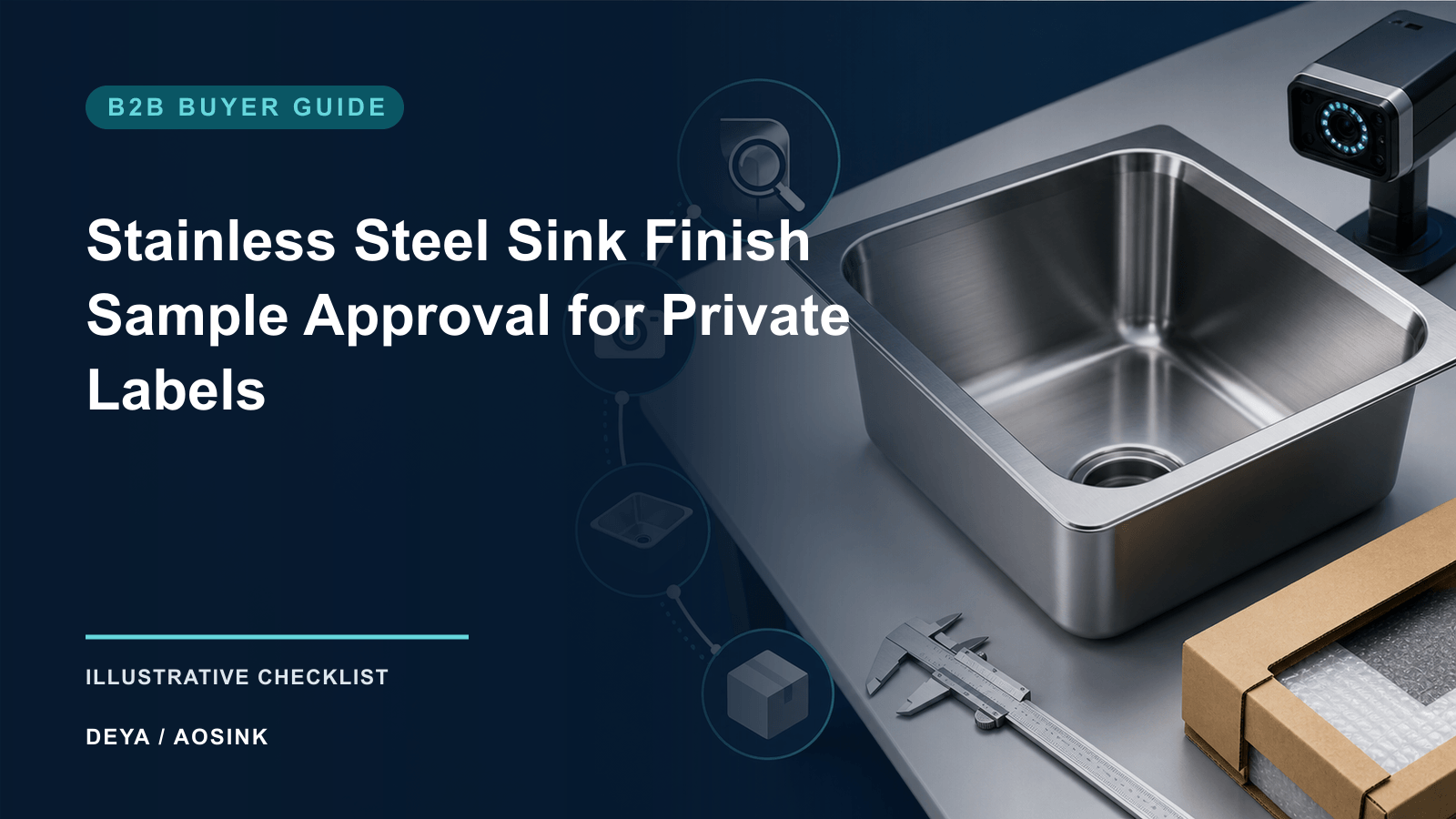
A finish name such as “brushed,” “satin” or “gunmetal” is not a complete acceptance standard. B2B buyers need a controlled physical reference, agreed viewing conditions and written defect limits so a supplier can reproduce the intended appearance across a production lot.
Separate material, process and appearance
Material grade, surface-processing route and final visual result are related but not interchangeable. A photograph cannot establish grade. A finish label alone cannot define scratch direction, gloss, texture, color or acceptable variation. Record each requirement in the appropriate document.
ASTM A480/A480M covers general requirements for flat-rolled stainless steel and describes standardized mill-finish designations within its scope. A formed sink’s commercial finish may include additional processing, so buyers should not assume a familiar finish word fully defines the finished product.
Create a controlled finish reference
- Assign the sample a unique ID, date and revision.
- Identify product model, substrate statement and finish process as supplied.
- Mark the approved viewing face and any directional grain.
- Store a physical master and, where practical, matched supplier and buyer samples.
- Record handling and replacement rules if the sample becomes scratched, faded or contaminated.
Define how appearance will be judged
Agree lighting type, approximate intensity, viewing distance, angle and observation time. Divide the sink into cosmetic zones: primary visible surfaces, secondary visible surfaces and concealed areas. A mark on the bowl floor may have a different commercial impact from one under the rim, but the distinction must be documented before inspection.
| Characteristic | Control question |
|---|---|
| Direction | Is the grain or pattern orientation defined for each visible area? |
| Uniformity | What variation is acceptable within one sink and among sampled units? |
| Defects | Which scratches, pits, dents, burn marks or coating gaps cause rejection? |
| Transitions | How should corners, weld areas, holes and edges appear? |
| Protection | What film or separator prevents damage after acceptance? |
Use instruments only where they answer a requirement
Color or gloss measurements can improve repeatability when the buyer defines the instrument, geometry, calibration, measurement location and tolerance. Numbers without a method are not comparable. Instrument readings should complement visual assessment of scratches, directionality and local defects.
Approve process limits, not just one attractive sample
Ask how the supplier controls abrasive condition, polishing direction, cleaning, coating batch, curing and handling where relevant. Do not infer production capability from a showroom sample. During trial production, compare multiple units and positions to the master reference and record variation.
Plan production and pre-shipment checks
Put the approved reference ID on the inspection plan. Define sample selection, cosmetic zones, lighting and defect classes. ISO 2859-1:2026 can structure lot-by-lot attribute sampling, but the buyer must choose the plan and acceptance criteria for the risk.
Frequently asked questions
Can phone photos be the finish standard?
No. Camera processing, screens and lighting change color, gloss and texture. Photos are useful records but should not replace a controlled physical reference where appearance is critical.
Is a finish sample permanent?
No. It needs identification, protected storage and replacement rules because wear or contamination can change its appearance.
Can one master sample cover every sink geometry?
Only if the buyer has verified that geometry and processing do not change the acceptance result. Corners, welds and deep-drawn areas may need model-specific references.
Does a finish designation prove corrosion performance?
No. Appearance terminology alone does not prove material grade, coating system, test result or service performance.
No responses yet